


Excel, QuickBooks and Gmail, with a person copy-pasting as the bridge, and a desk littered with yellow sticky notes. Jakob Nielsen distils a new INSEAD/Harvard field experiment into one blunt finding: startups taught to redesign end-to-end workflows around AI made 90% more revenue than peers who just sped up single tasks. The maths tracks too, a 10-step flow where doubling one step only trims total time by 5%.
This matters for design leads because the gains came from structure, not code. Treated teams applied AI across product and ops, kept headcount flat, and needed 40% less external capital. The recurring moves: remove handoffs, parallelise variants, move humans to exceptions, add eval loops.
If you run UX, start harvesting shadow AI: run ‘show me your prompt’ sessions, cluster the tricks, and promote the repeatable ones into the service blueprint. The case studies, from Gamma’s eval-driven shipping to FazeShift deleting the human glue between systems, are worth a close read. Profit lives in the workflow, not the widget.
 UX Tigers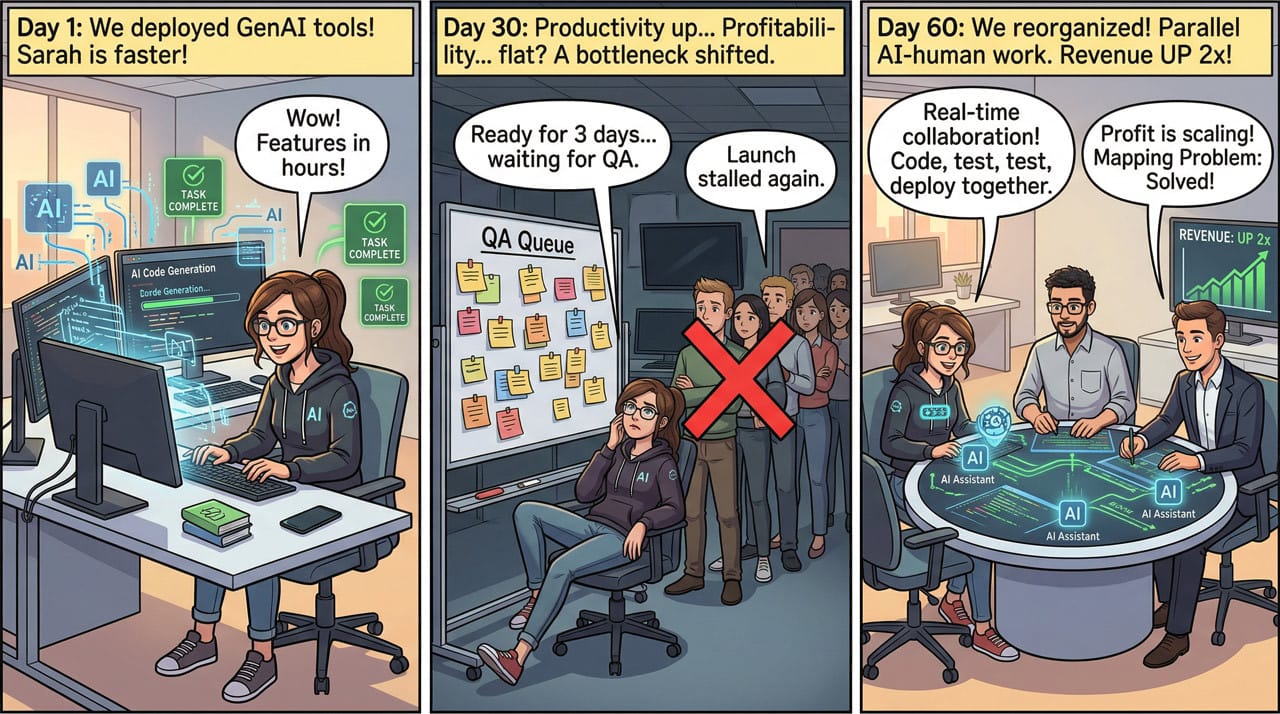


Discussion